Hyderabad's Skywalk Revolution: A Boon for Developers and Landowners in Gachibowli & Beyond
Published: September 2026
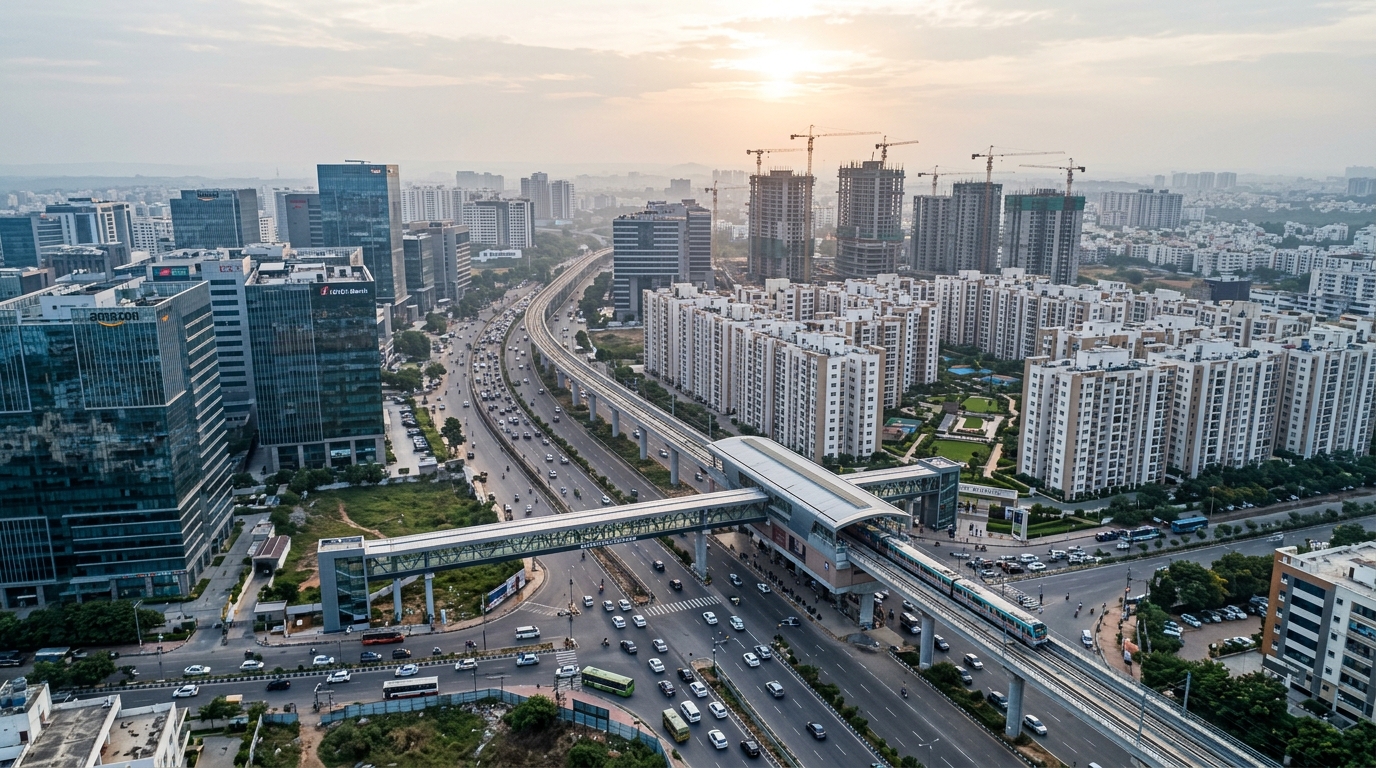
The Strategic Advantage: What This Means for Builders and Landowners
The announcement of a direct metro-to-township skywalk by Vaasavi Group is a game-changer for real estate development, particularly in rapidly expanding areas like Gachibowli, Kokapet, and the Financial District. For landowners, proximity to direct metro access dramatically enhances land value and attractiveness for development. Builders can now leverage this enhanced connectivity to market premium residential and commercial projects, promising unparalleled convenience for end-users. This development directly addresses the increasing demand for transit-oriented developments (TODs) which are becoming a critical factor in buyer decision-making, especially for the tech-savvy and upwardly mobile population in Hyderabad's western corridor.
This move signals a shift towards integrated living, where seamless access to public transport is no longer an afterthought but a core design principle. Developers who can strategically acquire land or partner with landowners in the vicinity of future metro stations, especially those with planned skywalk connections, will be positioned to capture significant market share. The reduced commute times and improved accessibility will justify premium pricing and attract a higher caliber of tenants and buyers, mitigating potential absorption risks in an increasingly competitive market.
- Increased land valuation for parcels near metro integration points.
- Enhanced marketability and premium pricing potential for residential and commercial projects.
- Attractiveness for transit-oriented developments (TOD) and integrated township concepts.
- Reduced buyer friction due to superior accessibility and commute efficiency.
Construction Trends, Approvals, and Supply Pipeline Implications
The construction of skywalks, especially those integrated with existing or planned metro lines, requires meticulous planning and coordination with transit authorities and urban development bodies. This signifies a growing trend towards public-private partnerships (PPPs) in urban infrastructure, opening avenues for developers to collaborate on value-added amenities. The approval process for such integrated projects can be complex, involving multiple government agencies. However, successful execution by Vaasavi Group will set a precedent and streamline future approvals for similar initiatives.
From a supply pipeline perspective, this development is likely to spur further investment in residential and commercial spaces along these newly connected corridors. The ability to offer 'metro-connected' living will drive demand for both apartment complexes and office spaces. Developers should anticipate a potential increase in construction material demand, particularly for specialized infrastructure components. Building contractors with expertise in elevated structures and urban infrastructure integration will be in high demand. The long-term implication is a more robust and connected urban fabric, encouraging densification in strategic locations and potentially easing pressure on existing road networks.
- Growing trend of Public-Private Partnerships (PPPs) in infrastructure-led development.
- Potential for streamlined approvals for integrated transit infrastructure projects.
- Increased demand for specialized construction expertise in elevated structures and urban integration.
- Stimulus for residential and commercial supply along enhanced connectivity corridors.
- Potential for increased demand for construction materials and associated labor.
Location Spotlight: Hyderabad's Western Corridor Opportunity
Hyderabad's Gachibowli, Kokapet, and Financial District are already established hubs for IT, finance, and research, attracting a large, affluent, and mobile workforce. The introduction of direct metro connectivity via a skywalk transforms these areas from merely desirable to exceptionally convenient. This is particularly pertinent for the Financial District and Gachibowli, where a significant number of professionals reside and work. Kokapet, with its ongoing large-scale residential developments, stands to benefit immensely, making its properties highly attractive to those seeking a blend of modern living and effortless commuting.
This development has the potential to address the existing supply-demand mismatch in these premium locations. While demand for housing and commercial space remains high, infrastructure bottlenecks have historically been a concern. The skywalk effectively tackles this by improving accessibility to the metro, thereby reducing reliance on private vehicles and alleviating traffic congestion. Developers should consider incorporating smart home features and co-working spaces within their projects to cater to the modern professional, further capitalizing on the enhanced lifestyle proposition offered by metro connectivity.
- Gachibowli: Enhanced connectivity for IT professionals and residential enclaves.
- Kokapet: Boost for large residential projects by integrating them with public transit.
- Financial District: Direct access for finance professionals, increasing attractiveness for businesses and residents.
- Addressing supply-demand mismatch through infrastructure-led demand creation.
- Opportunity to integrate lifestyle amenities and co-working spaces within developments.
Navigating Risks and Execution Challenges
While the opportunity is substantial, developers and landowners must be cognizant of potential risks. The primary challenge lies in the execution of the skywalk project itself. Delays in construction, cost overruns, or unforeseen engineering complexities can impact the project timeline and subsequently the planned real estate developments. Furthermore, regulatory hurdles and obtaining necessary clearances from multiple authorities can pose significant challenges.
For developers planning projects contingent on this skywalk, due diligence on the project's progress and stakeholder coordination is paramount. Understanding the long-term vision of the metro network expansion and other urban development plans in the vicinity is crucial. Economic downturns or shifts in demand for specific property types could also impact project viability. Therefore, a phased development approach and robust financial planning are essential to mitigate these risks and ensure successful project delivery, capitalizing on this significant infrastructure upgrade.
- Execution risks: Construction delays, cost overruns, and engineering complexities of skywalks.
- Regulatory hurdles and complexities in obtaining multiple clearances.
- Dependency on project completion timelines for downstream real estate developments.
- Market volatility and potential shifts in demand for residential and commercial spaces.
- Need for rigorous due diligence and stakeholder coordination.
Source: propnewstime.com