Hyderabad's Skyrocketing Land Values: A Wake-Up Call for Developers
Published: June 2026
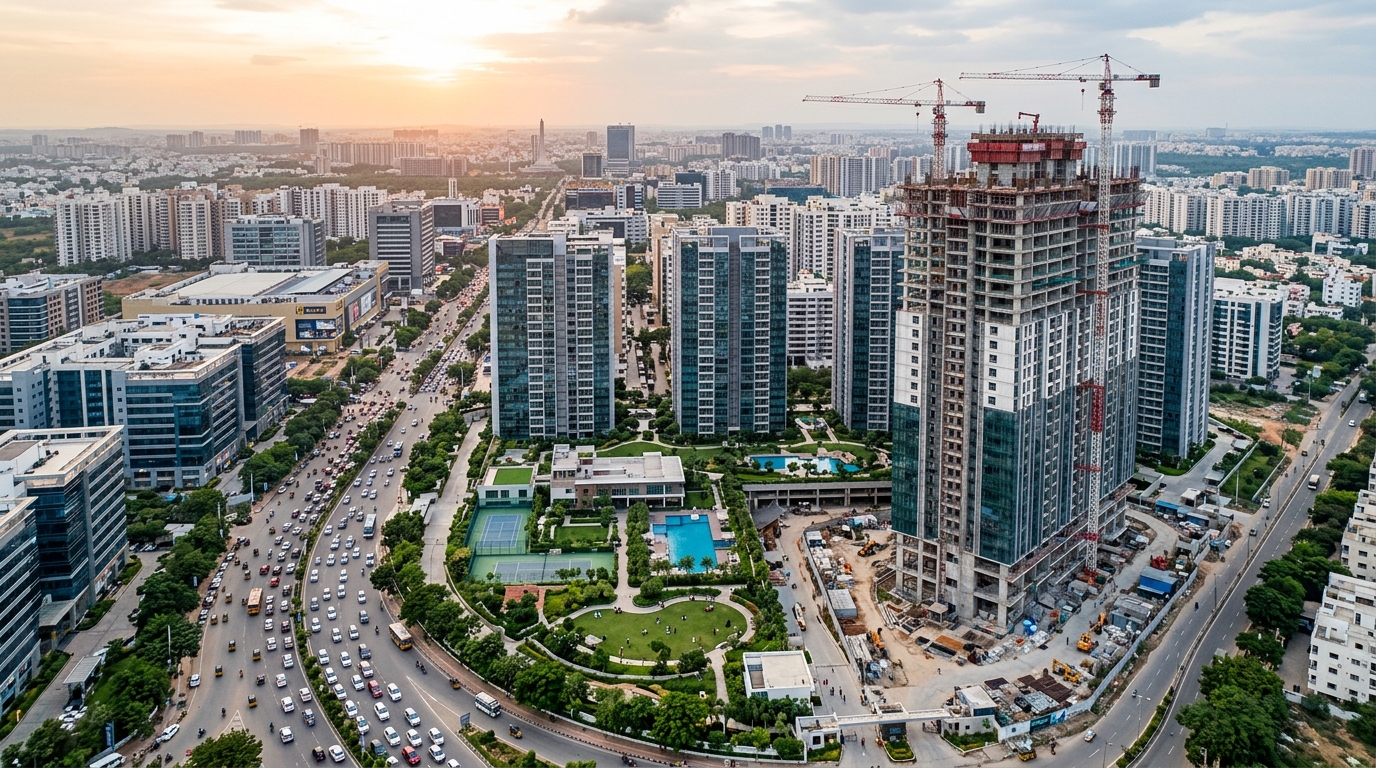
The Raidurg Benchmark: What It Means for Stakeholders
The recent record-breaking land transaction in Raidurg, Hyderabad, at a staggering INR 204 crore per acre, is not just a headline; it's a powerful indicator of the city's escalating real estate value. For landowners, this translates to immense wealth creation and a heightened expectation for premium pricing. Developers, on the other hand, face a new cost paradigm, necessitating a re-evaluation of project viability, target demographics, and return on investment (ROI) models. This benchmark price emphasizes the scarcity of prime land and the intense competition to acquire it, particularly in growth corridors.
This surge underscores the robust demand driven by Hyderabad's economic dynamism, its thriving IT sector, and its emergence as a major business hub. Developers must now strategize for projects that justify such high land acquisition costs. This likely means focusing on ultra-luxury residential offerings, premium commercial spaces, or mixed-use developments that can command superior rental yields or sales values. The ability to secure financing at competitive rates and achieve faster sales cycles will be crucial for mitigating the increased upfront investment.
- Landowners: Opportunity for significant capital appreciation and negotiation leverage.
- Developers: Need for higher project margins, innovative designs, and aggressive sales strategies.
- Investors: Potential for long-term capital gains, but with increased entry barriers.
Construction Trends, Approvals, and the Supply Pipeline
The escalating land prices will inevitably influence construction trends. Developers will be pushed towards maximizing plot utilization and opting for higher-density projects, where permissible. This could lead to an increased focus on vertical construction and mixed-use formats that combine residential, retail, and office spaces to optimize land use. The demand for premium amenities, sustainable building practices, and smart home technologies will also rise as developers aim to differentiate their offerings and justify higher ticket prices.
The approval process remains a critical factor. Delays in obtaining necessary permits can significantly impact project timelines and inflate costs, especially with rising land values. Streamlining these processes and ensuring regulatory clarity are paramount. The current supply pipeline for prime residential and commercial spaces in these high-demand micro-markets might be perceived as insufficient to meet the projected future demand, potentially creating a supply-demand mismatch. Developers need to conduct thorough market analysis to identify specific unmet needs and launch projects that cater to them efficiently.
- Focus on higher-density and vertical construction.
- Increased demand for premium and smart building features.
- Importance of efficient construction management and timely approvals.
- Addressing potential supply-demand gaps in prime locations.
Location Spotlight: Gachibowli, Kokapet, and the Financial District
The INR 204 crore per acre figure is intrinsically linked to the desirability of the Raidurg area, which is in close proximity to Hyderabad's premier business districts. Gachibowli, the established IT hub, and the rapidly developing Kokapet and Financial District are prime beneficiaries and contributors to this land price surge. These locales are characterized by a high concentration of corporate offices, premium residential enclaves, educational institutions, and world-class infrastructure, attracting a discerning clientele with substantial purchasing power.
The continued expansion of the IT and BFSI sectors in these zones fuels demand for both residential and commercial real estate. Developers with existing land banks or the capability to acquire parcels in these sought-after micro-markets are positioned for significant gains. However, the competition is fierce, and the entry barrier is exceptionally high. Projects in these areas must offer exceptional value propositions, whether through exclusive amenities, unique architectural designs, or strategic locational advantages, to stand out and attract buyers willing to pay a premium.
- Gachibowli: Established IT hub, sustained residential and commercial demand.
- Kokapet: Rapid development, high potential for premium residential and mixed-use projects.
- Financial District: Prime commercial and high-end residential demand.
- Competition is intense; value proposition is key.
Navigating Risks and Execution Challenges
While the current market sentiment is buoyant, developers must tread cautiously, mindful of the inherent risks. The most significant challenge is the sheer cost of land acquisition, which demands meticulous financial planning and robust pre-sales strategies. Market cycles can turn, and a significant increase in interest rates or a slowdown in economic growth could impact affordability and buyer sentiment, leading to potential sales velocity issues. High construction costs, driven by material and labor price fluctuations, also pose a considerable risk.
Execution challenges include navigating complex regulatory frameworks, managing stakeholder expectations, and ensuring timely project completion with uncompromising quality. The ability to secure financing for projects with such high upfront costs is also a critical factor. Developers must focus on building strong relationships with financial institutions and demonstrating a clear path to profitability. Furthermore, maintaining brand reputation and delivering on promised amenities are crucial for long-term success in a competitive landscape where buyer expectations are exceptionally high.
- High upfront land acquisition costs and financing challenges.
- Vulnerability to market cycles, interest rate fluctuations, and economic slowdowns.
- Rising construction material and labor costs.
- Navigating regulatory hurdles and ensuring quality execution.
- Meeting exceptionally high buyer expectations in premium segments.
Source: Prop News Time