Hyderabad's Premium Residential Market Surges: Decoding Investor Sentiment and Future Growth Drivers
Published: October 2026
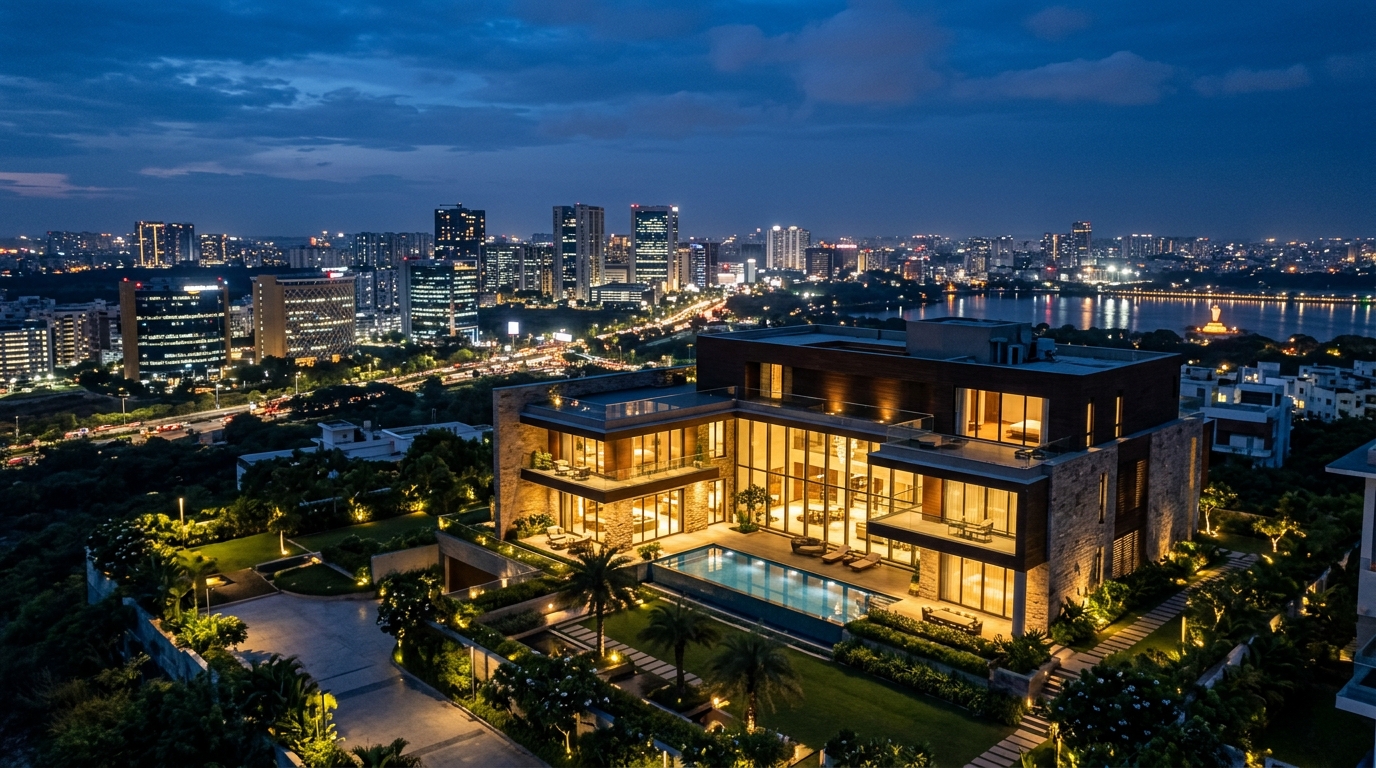
Unprecedented Demand in Hyderabad's Prime Real Estate
Hyderabad's luxury real estate market is experiencing a significant upswing, with recent transactions in the Kokapet and Financial District micro-markets setting new benchmarks. The reported sale of premium villas at an average price of ₹10-12 crore, and a staggering ₹60 crore for a penthouse, underscores a burgeoning demand for high-end residences. This surge is driven by a confluence of factors including increasing disposable incomes, a growing population of high-net-worth individuals (HNIs) attracted by the city's robust IT and financial sectors, and a perception of Hyderabad as a stable and high-potential investment destination.
The sheer volume of transactions, exceeding ₹1,000 crore in a short span, highlights the depth of the market and the willingness of buyers to invest substantial capital in premium properties. This is not just about end-user demand; it also points to an increasing trend of real estate being viewed as a significant asset class for wealth preservation and appreciation among HNIs.
Supply Dynamics and Pricing Trends in Premium Enclaves
The demand surge is rapidly influencing supply dynamics. While developers are seeing an unprecedented uptake of existing premium inventory, the pace of new project launches in this segment needs to align with the evolving demand. The pricing achieved in recent deals, with villas commanding ₹6,000-7,000 per square foot and the penthouse reaching ₹12,000 per square foot, suggests a premium for exclusivity, bespoke amenities, and prime location. This pricing power is likely to sustain, provided the underlying economic drivers remain strong and the supply pipeline is managed judiciously to avoid oversupply.
The success of projects in areas like Kokapet, known for its large land parcels and potential for integrated developments, and the established Financial District, with its existing infrastructure and corporate presence, indicates a clear investor preference for well-connected, aspirational addresses. This also implies that land acquisition and development costs in these micro-markets will continue to command a premium.
Institutional Investor Perspective: A Golden Opportunity
From an institutional investor's standpoint, Hyderabad's premium residential market presents a compelling case for capital allocation. The consistent performance, driven by sustained demand from a growing affluent demographic and a relatively stable economic environment, offers attractive risk-adjusted returns. Institutional investors are likely to be drawn to:
1. **Bulk Deals & Portfolio Diversification:** The ability to acquire significant stakes in upcoming premium projects or even entire developments can lead to diversification within their real estate portfolios.
2. **Joint Ventures & Development Partnerships:** Collaborating with established developers on large-scale, high-value projects in these prime micro-markets offers an avenue for significant capital deployment and profit sharing.
3. **Long-Term Appreciation Potential:** The underlying economic growth drivers of Hyderabad, particularly the IT and financial services sectors, suggest a sustained demand for quality residential spaces, ensuring long-term capital appreciation.
4. **Yield Enhancement:** Beyond capital appreciation, the rental yields in these premium locations are also expected to be robust, catering to expatriates and senior executives working in the nearby corporate hubs.
- Focus on established developers with a proven track record in delivering luxury projects.
- Due diligence on project master plans, amenities, and connectivity to key employment hubs.
- Understanding local zoning regulations and approval processes for large-scale developments.
Policy and Regulatory Landscape
While the news doesn't explicitly detail policy changes, the booming real estate market in Hyderabad, particularly the high-value transactions, will inevitably attract regulatory scrutiny. Such substantial capital flows can lead to enhanced focus on transparency, anti-money laundering (AML) checks, and potentially a review of property tax structures to ensure fairness and adequate revenue generation for the state. Developers and institutional investors alike must remain abreast of any evolving government policies related to land use, stamp duty, registration charges, and RERA compliance to navigate the market smoothly. The state government's proactive approach to infrastructure development, which has been a key enabler for the growth of micro-markets like Gachibowli and Kokapet, is a positive factor that institutional investors will monitor closely.
The sheer volume of transactions also suggests a potential for increased government revenue collection through stamp duty and registration fees. This could further incentivize the government to maintain policies that support a healthy real estate market while ensuring due diligence and compliance.
Micro-Market Focus: Gachibowli, Kokapet, and the Financial District
The standout performance of Kokapet and the Financial District is directly attributable to their established status as prime business and residential hubs. The Financial District, with its concentration of major IT companies and financial institutions, naturally draws a high-earning workforce seeking premium accommodation in close proximity. Kokapet, with its strategic location and ample land availability, has emerged as a prime target for developers building large-scale, integrated luxury townships and premium independent villas, effectively catering to the overflow demand and offering more expansive living spaces.
Gachibowli, often considered an extension of the Financial District's ecosystem, also benefits indirectly from this demand, as buyers look for well-connected, albeit slightly less exclusive, options. The sustained growth in these micro-markets, fueled by job creation and infrastructure development, reinforces their position as growth corridors and attractive investment destinations for both end-users and institutional capital.
Source: regnews.in