Hyderabad's Next Growth Frontier: New Economic Centres to Redefine Real Estate Investment Landscape
Published: August 2026
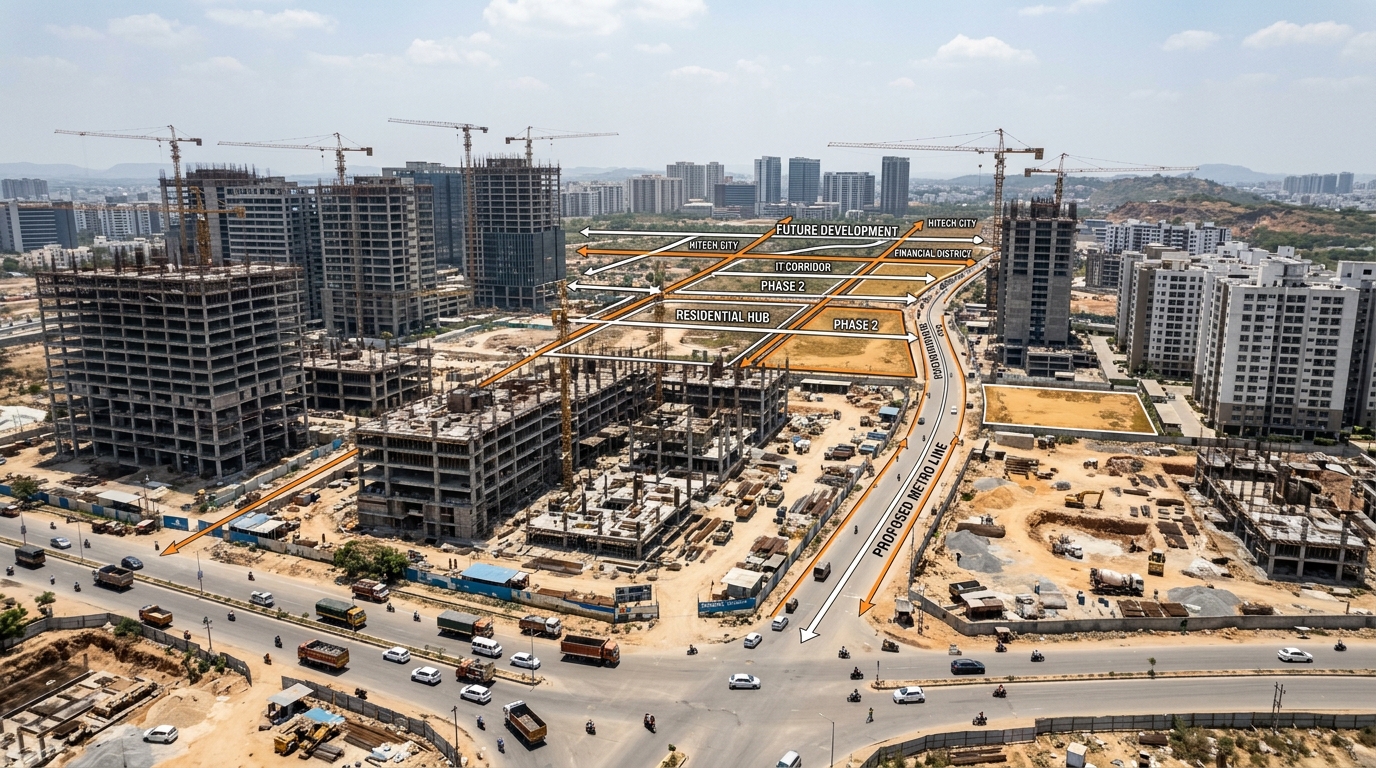
Unlocking New Demand and Supply Dynamics
The Telangana government's initiative to develop new economic centres on the outskirts of Hyderabad is a strategic play to decentralize economic activity and accommodate future growth. This expansion will inevitably lead to increased demand for both commercial and residential real estate as businesses establish their presence and employees seek housing in proximity. While the immediate impact will be felt in areas designated for these new centres, it will also create a ripple effect, potentially easing pressure on saturated prime locations and opening up new investment horizons.
From a supply perspective, this development necessitates significant land acquisition and infrastructure development. Developers will need to cater to a diverse range of needs, from Grade-A office spaces and industrial parks to modern residential enclaves and supporting retail infrastructure. Early movers who can anticipate the infrastructure development and land availability in these emerging zones are likely to capture significant value appreciation.
Institutional Investor Perspective: A Capital Flow Magnet
For institutional investors, Hyderabad's expansion into new economic hubs presents a compelling narrative for long-term capital deployment. The promise of robust job creation and economic diversification in these new centres is a strong indicator of sustained rental growth and capital appreciation. These investors will be closely evaluating the government's commitment to infrastructure development, including road networks, utilities, and public transportation, which are critical for the success of any new economic zone. Areas with established connectivity and a clear roadmap for development will be prime targets.
The expansion will likely attract a mix of domestic and international institutional capital, eager to capitalize on the potential for high yields and diversified portfolios. Focus will be on large-scale, integrated developments that can offer a comprehensive ecosystem for businesses and residents, thereby minimizing risk and maximizing returns. The potential for creating new 'growth corridors' similar to the success of Gachibowli and the Financial District will be a key consideration.
- Focus on integrated townships and mixed-use developments.
- Emphasis on Grade-A commercial office spaces with superior amenities.
- Strategic investments in land parcels with clear development potential and infrastructure linkages.
- Scrutiny of government land-pooling and development policies.
Policy and Regulatory Landscape: Enabling Growth
The success of these new economic centres will be heavily influenced by the policy and regulatory environment. The Telangana government's commitment to facilitating land acquisition, streamlining approvals, and providing necessary infrastructure will be paramount. Investors will be keenly observing the clarity and efficiency of these processes. Proactive policy measures aimed at attracting anchor tenants and ensuring sustainable urban planning will be crucial in de-risking investments.
Furthermore, any incentives or special economic zone (SEZ) status granted to these new areas could significantly boost investor confidence and accelerate development. A supportive regulatory framework, coupled with robust enforcement, will be essential to foster a conducive investment climate and ensure the long-term viability of these burgeoning economic hubs.
Micro-Market Implications: Beyond the Core
While the news doesn't specify exact locations, the expansion suggests a move away from the immediate confines of the existing IT hubs like Gachibowli and the Financial District. New economic centres will likely emerge in peripheral areas, creating new micro-markets with unique investment characteristics. These areas may offer more competitive land prices initially, presenting an opportunity for early-stage, value-driven investments.
The development of these new centres will also influence existing prime micro-markets. While some demand might be siphoned off, it could also lead to a re-evaluation and repositioning of these established hubs, potentially driving up rental values for premium spaces as companies seek to retain their presence in established, well-connected locations. Investors should analyze the planned infrastructure connectivity between the new centres and the existing city core to understand these evolving dynamics.
- Emergence of new peripheral micro-markets with early-mover advantages.
- Potential for increased land values in designated development zones.
- Impact on demand and rental yields in established IT corridors (e.g., Gachibowli, Financial District).
- Importance of assessing infrastructure connectivity to the city center.
Source: The Times of India