Hyderabad's IT Corridor Stalled: A ₹2,000 Crore Land Dispute Casts a Shadow on Prime Real Estate
Published: August 2026
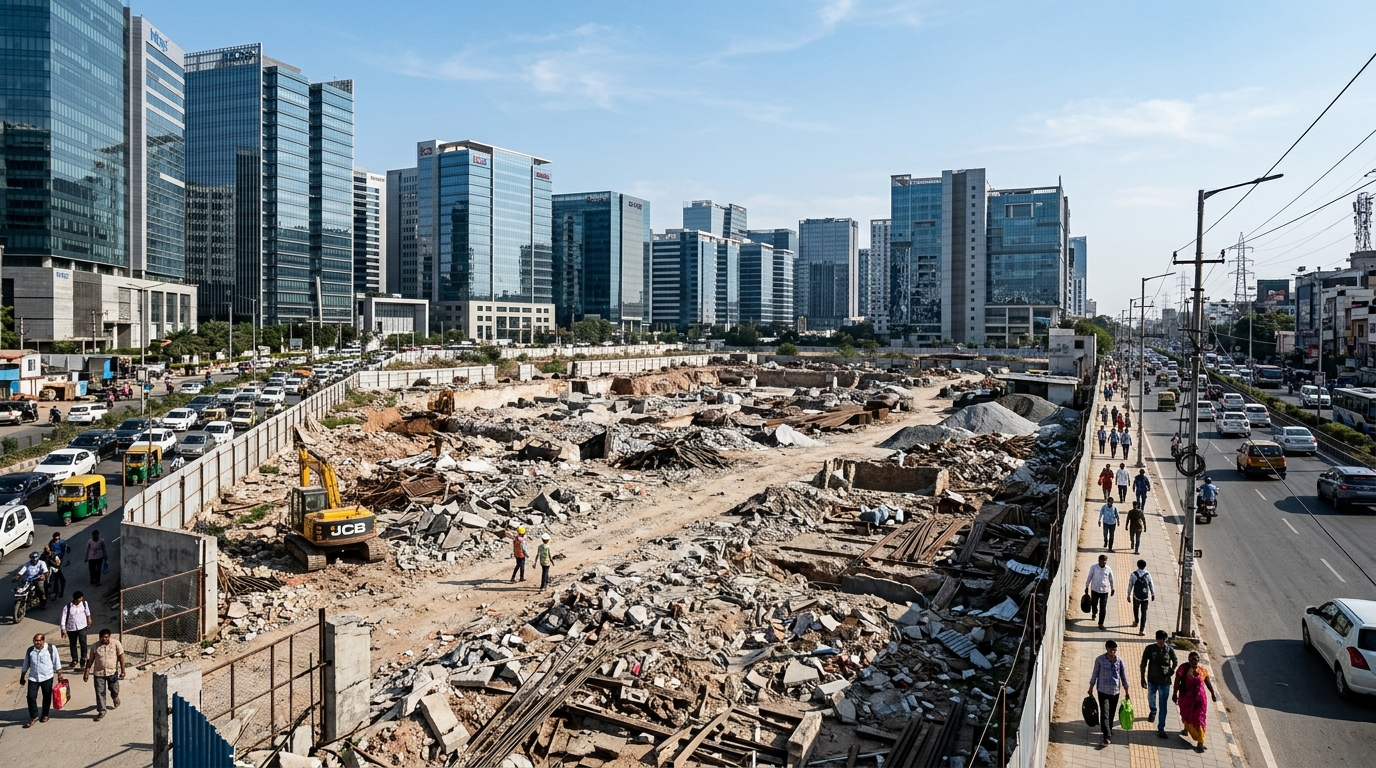
The Bottleneck: A Prime Parcel Lost in Litigation
A significant ₹2,000 crore land parcel, strategically located within Hyderabad's dynamic IT corridor, has become a casualty of a decades-old legal dispute. The ET Realty report highlights how this prime real estate, situated amidst high-growth economic zones, remains undeveloped, buried under the weight of protracted litigation and administrative inertia. This situation directly impacts potential supply within one of India's most sought-after real estate markets, particularly affecting the nodes of Gachibowli and the Financial District.
The immediate implication for the market is a reduction in available developable land in an area experiencing robust demand from both residential and commercial sectors. This scarcity, when coupled with ongoing absorption rates driven by IT and ITES sector expansion, could exert upward pressure on land and property prices in adjacent micro-markets. The delay in unlocking this ₹2,000 crore asset represents a missed opportunity for significant supply infusion that could have potentially moderated speculative price increases.
Institutional Investor Scrutiny and Capital Flow Implications
For institutional investors, this news serves as a stark reminder of the critical importance of meticulous due diligence and understanding the legal and regulatory landscape of any potential acquisition in India. While Hyderabad's IT hub continues to attract significant capital due to its strong fundamentals, a burgeoning IT workforce, supportive government policies, and a vibrant ecosystem, such land disputes can erode investor confidence and trigger a more cautious approach.
The ₹2,000 crore value of the land underscores the scale of capital that could have been deployed. A resolution to this dispute would not only unlock immediate development potential but also signal to investors that complex legal challenges can be overcome, thereby de-risking future investments in similar high-value land parcels. Conversely, prolonged litigation might lead to a reallocation of capital towards markets with clearer title histories or projects with more transparent development pathways. This incident reinforces the need for robust legal vetting and risk mitigation strategies for funds looking to deploy substantial capital in India's real estate sector.
Increased scrutiny on land titles and legal encumbrances.
Potential for capital diversion to less litigious markets.
Emphasis on pre-development risk assessment for large-scale projects.
Reinforcement of the need for strong local partnerships with legal expertise.
Policy, Regulation, and Micro-Market Context
While the specific policy or regulatory triggers for this decades-old dispute are not detailed, its persistence points to potential inefficiencies in the land dispute resolution mechanisms within the Indian legal system. For a city like Hyderabad, striving to maintain its status as a global IT destination, such unresolved issues can act as a significant drag on growth, deterring large-scale FDI and domestic investment.
The affected area is implicitly within or adjacent to sought-after micro-markets like Gachibowli and the Financial District, which are characterized by high demand for Grade A commercial office spaces and premium residential developments. The lack of a resolved title for this land prevents its integration into the urban fabric, impacting future urban planning and the potential for mixed-use developments that are crucial for sustainable growth in these hubs. A swift resolution, potentially through judicial or administrative intervention, could significantly boost investor sentiment and accelerate development in these prime Hyderabad locations.
Source: ET Realty