Accenture's Mega Hyderabad Lease: A Bellwether for Office Real Estate Demand and Institutional Capital
Published: June 2026
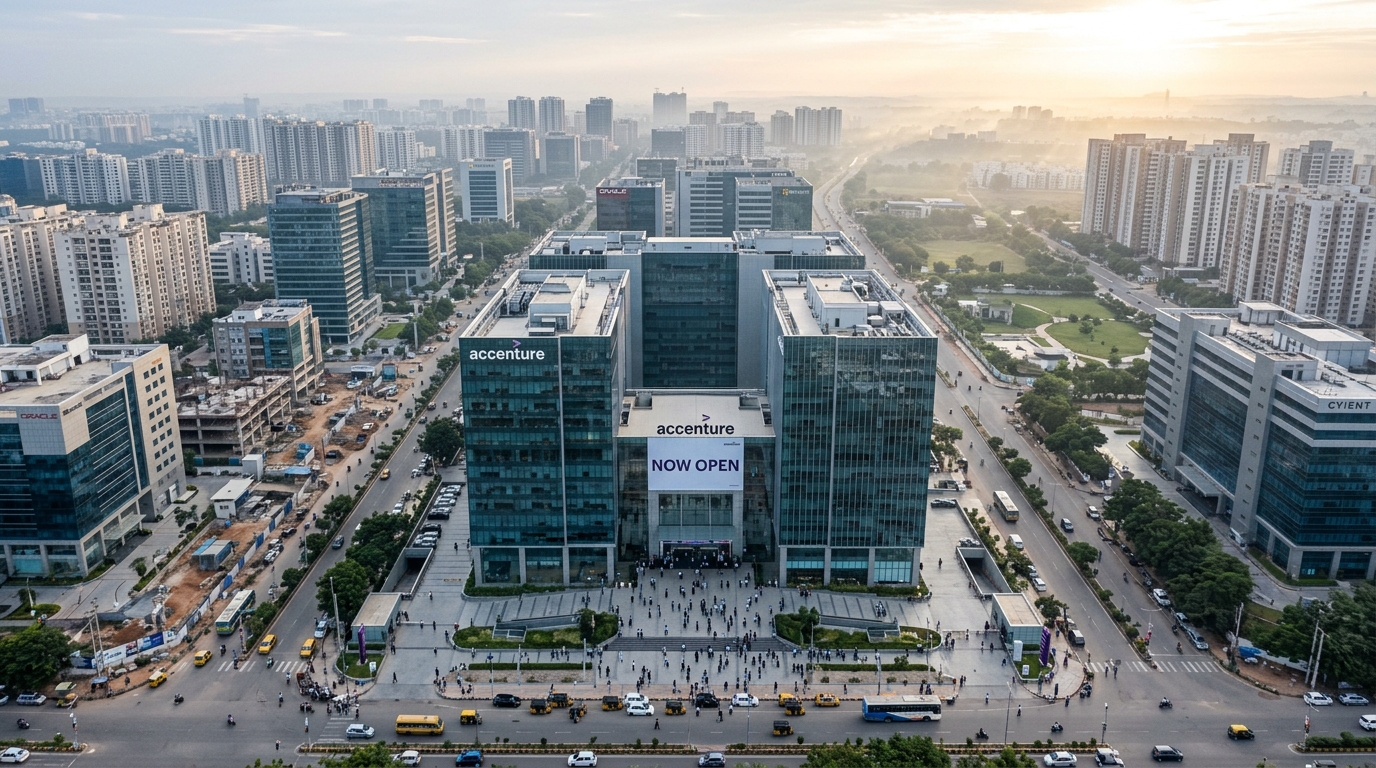
Decoding the Market Implications: Demand, Supply, and Pricing Dynamics
Accenture's significant office space acquisition directly addresses the demand side of the commercial real estate equation. Committing to over 1 million sq ft indicates a strong expansionary strategy, likely driven by workforce growth and a need for consolidated, modern workspaces. This substantial uptake by a major global IT services firm validates the sustained demand for Grade A office inventory, particularly in established business hubs. The long-term nature of the lease (10 years) suggests confidence in the Hyderabad market's stability and growth prospects, implying potential upward pressure on rental values in prime micro-markets as supply struggles to keep pace with such large-scale absorptions.
From a supply perspective, this lease highlights the critical need for continued development of high-quality office spaces. While Hyderabad has seen significant construction, the absorption of such a large parcel suggests that the existing and pipeline supply in strategically located areas will be tested. Developers and investors will likely view this as a signal to accelerate new projects or expand existing ones, especially in areas with proven tenant demand. The pricing implications are also noteworthy; significant pre-leasing or sustained high occupancy rates in similar buildings can justify premium rental rates, benefiting landlords and attracting further investment.
- Increased demand for Grade A office spaces in Hyderabad.
- Validation of sustained IT/ITES sector growth in the region.
- Potential upward pressure on rental values in prime micro-markets.
- Reinforced need for continued development of high-quality office supply.
An Institutional Investor's Perspective: Capital Flows and Risk Assessment
For institutional investors, Accenture's lease is a strong positive indicator. It signifies a major corporate occupier with a solid credit profile locking in a long-term commitment, which de-risks office assets and enhances their attractiveness for investment. Such large anchor tenants provide stable rental income streams, crucial for Real Estate Investment Trusts (REITs) and private equity funds seeking predictable returns. This transaction is likely to catalyze further capital inflows into Hyderabad's commercial office sector, as investors view it as a testament to the market's resilience and its capacity to attract and retain global corporations.
The choice of Hyderabad by a firm like Accenture, known for its rigorous site selection process, signals confidence in the city's talent pool, infrastructure, and business ecosystem. Institutional investors will interpret this as a confirmation of Hyderabad's status as a Tier-1 investment destination. The focus will now shift to identifying other emerging micro-markets or specific projects that can cater to similar large-scale requirements, potentially leading to increased valuations and transaction volumes across the city's office portfolio.
- De-risking of office assets due to a strong anchor tenant.
- Attraction of further capital from REITs and private equity.
- Confirmation of Hyderabad as a preferred investment destination.
- Increased valuations and transaction volumes in the commercial office sector.
Micro-Market Dynamics: Hyderabad's Prime Office Hubs
While the specific location of Accenture's new office isn't detailed in the news, such large-scale leases typically gravitate towards established or rapidly developing commercial corridors. In Hyderabad, this often means areas like Gachibowli, the Financial District, and potentially newer emerging zones like Kokapet. These micro-markets are characterized by their robust infrastructure, proximity to talent pools, and a concentration of IT/ITES companies, making them highly desirable for global corporations.
The ability to secure over 1 million sq ft suggests that these micro-markets possess the necessary scale and development potential to accommodate such mega-deals. A sustained influx of large tenants into these zones will likely drive further infrastructure development and amenity enhancements, solidifying their position as prime office destinations and potentially leading to a premium in rental growth compared to less developed areas. This reinforces the strategic importance of understanding the granular dynamics within these specific micro-markets when making investment decisions.
- Focus on established and developing commercial corridors like Gachibowli, Financial District, and Kokapet.
- Correlation between large leases and infrastructure/amenity development.
- Differentiated rental growth potential across micro-markets.
- Importance of granular market analysis for investment strategy.
Policy and Regulatory Environment: An Unspoken Enabler?
While the news doesn't explicitly mention policy or regulatory impacts, the sustained growth of Hyderabad's IT sector, which fuels such office demand, is often supported by pro-business government policies. Initiatives aimed at improving ease of doing business, providing infrastructure support, and fostering a skilled workforce create an environment conducive to large-scale corporate expansions. For instance, policies related to Special Economic Zones (SEZs) or IT policies that offer incentives can indirectly encourage multinational corporations to expand their footprint.
Institutional investors closely monitor the regulatory stability and predictability of a market. A consistent and supportive policy framework in Telangana, particularly concerning real estate and business operations, provides the assurance needed for long-term capital commitments. While not a direct regulatory action, the consistent economic growth and supportive environment in Hyderabad, facilitated by such policies, is an underlying factor in why companies like Accenture feel confident making such substantial investments.
- Indirect impact of pro-business government policies on IT sector growth.
- Importance of ease of doing business and infrastructure support.
- Regulatory stability as a key factor for institutional investor confidence.
- Role of SEZs and IT policies in attracting corporate expansions.
Source: The Economic Times