Hyderabad's Shifting Landscape: Vineyards Succumb to Urban Sprawl, Creating New Real Estate Opportunities
Published: August 2026
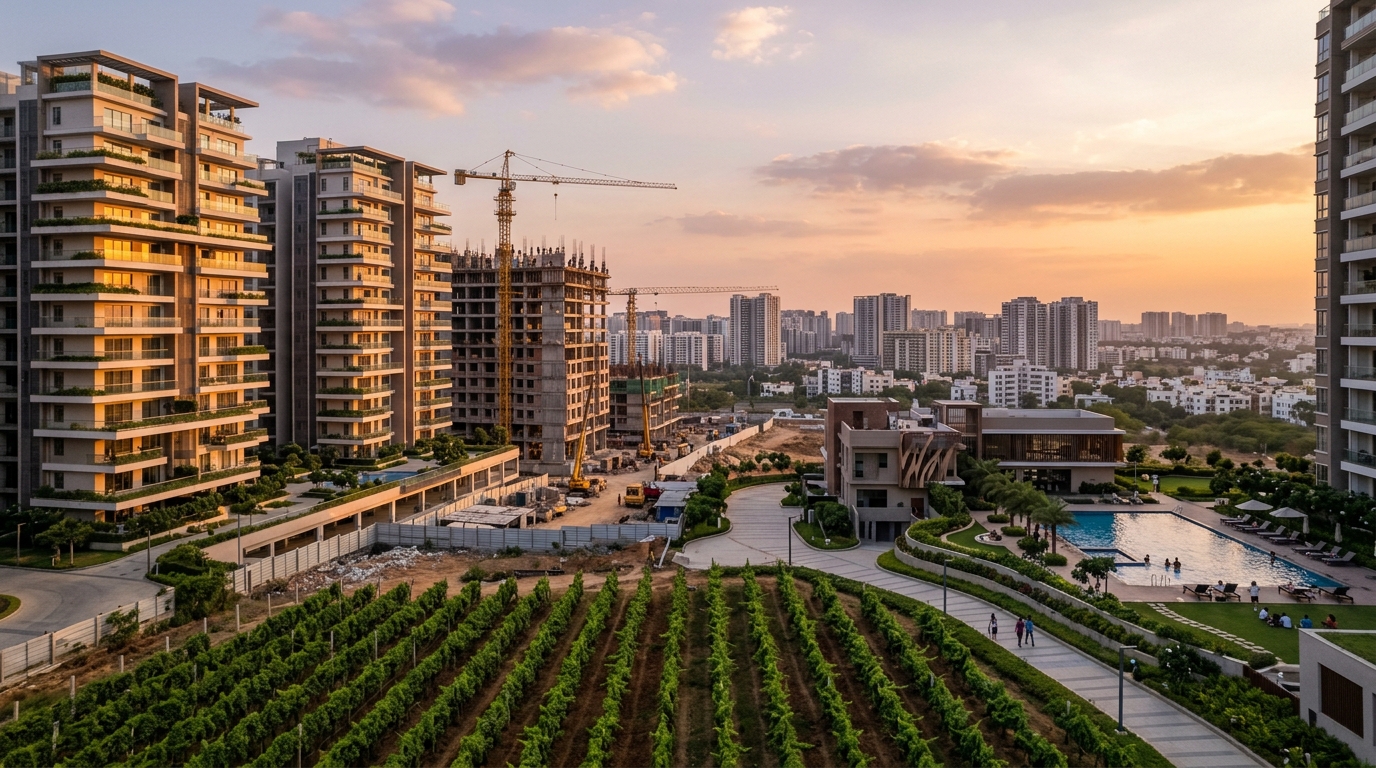
The Metamorphosis of Hyderabad's Periphery
The recent news highlighting the conversion of Hyderabad's vineyards into real estate projects underscores a common narrative in rapidly urbanizing cities. As Hyderabad's economy expands, driven by its IT and services sectors, the demand for land for residential, commercial, and infrastructural development intensifies. This pressure inevitably leads to the conversion of agricultural land, including historically significant vineyard areas, to accommodate this growth. This trend is particularly evident in areas surrounding the city that were previously characterized by open spaces and agriculture.
Market Implications: Demand, Supply, and Pricing Dynamics
The conversion of agricultural land to develop new real estate projects directly impacts supply dynamics. While it increases the available land for construction, it simultaneously reduces the supply of agricultural land, potentially leading to higher land acquisition costs for developers in prime areas. For the real estate market, this translates to a potential increase in housing and commercial property prices in these evolving micro-markets as demand continues to outpace supply. The scarcity of developable land in established hubs like Gachibowli and the Financial District will likely push development further outwards, creating new growth corridors.
The demand for housing, particularly for the burgeoning workforce in Hyderabad's IT corridors, remains robust. This persistent demand, coupled with the finite nature of developable land, creates a fertile ground for property appreciation. Investors should monitor the pace of approvals and infrastructure development in these newly emerging zones to capitalize on early-stage growth potential.
- Increased land acquisition costs for developers due to agricultural land conversion.
- Potential rise in residential and commercial property prices in developing micro-markets.
- Shifting demand towards peripheral areas as core hubs become saturated.
Institutional Investor Perspective and Capital Flow
From an institutional investor's standpoint, this trend presents a dual opportunity and challenge. The conversion of vineyards signifies a long-term commitment to urban expansion, indicating stable demand for real estate. Institutional capital, typically seeking larger land parcels and opportunities for large-scale integrated developments, will likely be drawn to these conversion zones. These investors can participate by funding large-scale residential townships, commercial parks, and mixed-use developments that absorb the displaced agricultural land. The focus will be on identifying micro-markets with strong underlying demand drivers, such as proximity to employment hubs like Gachibowli and the Financial District, and robust infrastructure plans.
The direction of capital flow is likely to pivot towards these peri-urban areas, where land is relatively more affordable but offers significant upside potential as connectivity and amenities improve. Diversification into land banking and opportunistic acquisitions in these zones will be key strategies for institutional players looking to gain exposure to Hyderabad's growth story.
- Opportunity for large-scale integrated developments in newly designated real estate zones.
- Focus on micro-markets with proximity to IT hubs and planned infrastructure.
- Capital allocation towards land banking and opportunistic acquisitions in peripheral areas.
Policy and Regulatory Considerations
The conversion of agricultural land to non-agricultural purposes is typically governed by specific government policies and regulations. Local authorities in Hyderabad would have zoning laws and land-use conversion guidelines that developers must adhere to. Any policy changes that streamline or restrict such conversions can significantly impact the pace and cost of development. For investors, understanding these regulatory frameworks is crucial for due diligence and risk assessment. Areas like Kokapet and the Financial District, already established as premium commercial and residential zones, may see increased pressure on surrounding agricultural lands for further expansion, necessitating careful policy oversight.
- Adherence to zoning laws and land-use conversion guidelines.
- Impact of policy changes on development pace and costs.
- Importance of regulatory oversight in emerging development corridors.
Micro-Market Focus: Gachibowli, Kokapet, and the Financial District
The pressure on agricultural land is most acutely felt in the vicinities of Hyderabad's prime business districts. Areas surrounding Gachibowli, Kokapet, and the Financial District, already experiencing rapid residential and commercial development, are likely to see adjacent vineyard lands being targeted for conversion. This phenomenon will contribute to the densification of these already high-demand micro-markets. Consequently, developers will either build upwards within these established zones or expand into the next ring of previously agricultural land. Investors should closely examine the infrastructure development plans for these expanding peripheries, as improved connectivity and amenities will be critical in driving the value of new projects in these areas.
- Increased development pressure around Gachibowli, Kokapet, and the Financial District.
- Densification of existing prime micro-markets.
- Importance of infrastructure development in new growth corridors.
Source: The Times of India