CREDAI Hyderabad Property Show: A Bellwether for Investor Confidence and Market Dynamics
Published: July 2026
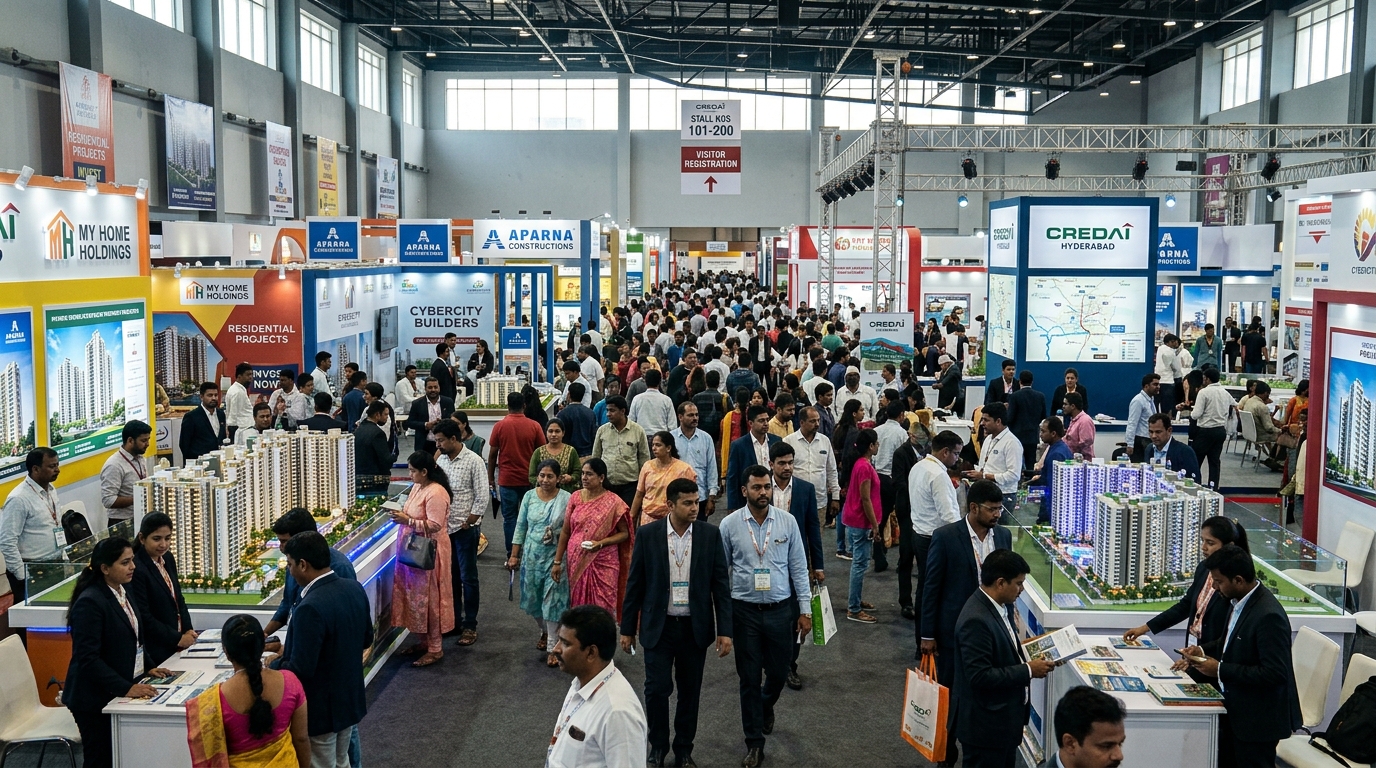
Market Implications: Demand Signals and Supply Dynamics
The CREDAI Hyderabad property show, a significant event for real estate developers and prospective buyers, serves as a key indicator of current market sentiment. Its timing suggests developers are optimistic about sustained buyer interest, particularly in the wake of previous economic uncertainties. The sheer scale of such an exhibition typically reflects an anticipated uptick in demand across various segments, from residential to commercial properties. For investors, this event provides a ground-level assessment of inventory pipelines and new project launches, helping to forecast future supply and its potential impact on pricing. A robust turnout and high sales conversion rates at the show would strongly signal continued demand-driven price appreciation.
Historically, property shows organized by prominent bodies like CREDAI often translate into a surge in sales bookings. This is driven by the consolidated offering of multiple projects, attractive festival-season deals (often coinciding with such exhibitions), and the confidence instilled by reputable developers. From a supply perspective, the range and type of projects showcased will reveal developer strategies. An emphasis on affordable housing might indicate a response to broader economic trends, while a focus on luxury or integrated townships could point towards sustained demand from higher-income segments and expatriates. The event will also highlight the pace at which new inventory is being brought to market, offering clues about potential oversupply or undersupply in specific micro-markets.
Potential for increased buyer inquiries and on-ground sales conversions.
Insight into developer confidence and new project pipeline.
Early signals on pricing trends based on booking velocity and developer offers.
Understanding of shifting supply-side strategies across property segments.
Institutional Investor Perspective and Capital Flows
For institutional investors, including Real Estate Investment Trusts (REITs), private equity funds, and sovereign wealth funds, events like the CREDAI Hyderabad property show are not just about retail sales; they are crucial for understanding underlying market fundamentals and identifying potential investment avenues. A successful show, characterized by high footfall and significant booking figures, validates the growth narrative of Hyderabad's real estate sector, attracting further institutional capital. Conversely, a subdued response might prompt investors to reassess risk profiles and seek out more resilient micro-markets or asset classes.
The data gleaned from such events, ranging from buyer demographics and preferred property types to developer pricing strategies and absorption rates, informs sophisticated financial modeling and strategic allocation decisions. Institutional investors will be particularly interested in projects that align with their long-term growth strategies, such as those in Grade A commercial spaces, well-planned residential communities in high-growth corridors, and potentially niche segments like student housing or senior living if they are represented. The exhibition can also act as a platform for developers to signal their readiness for joint ventures or capital infusions, directly influencing the direction and volume of capital flows into the Hyderabad real estate ecosystem.
Validation of market growth for attracting institutional capital.
Identification of promising investment opportunities and high-potential micro-markets.
Assessment of developer financial health and project viability.
Signaling opportunities for joint ventures and strategic partnerships.
Micro-Market Relevance: Hyderabad's Growth Corridors
While the event is city-wide, the spotlight will inevitably fall on Hyderabad's premier growth corridors. Areas like Gachibowli, Kokapet, and the Financial District, known for their IT and business hubs, consistently drive demand for both residential and commercial real estate. The property show will likely showcase a significant number of projects catering to the workforce in these vicinities, offering a clear picture of the residential absorption capacity and rental yields in these micro-markets. Developers are expected to highlight their offerings that provide connectivity, modern amenities, and proximity to employment centers, appealing to both end-users and investors looking for capital appreciation and rental income.
The pricing trends observed in these specific micro-markets during the exhibition will be a key takeaway. For instance, the availability of premium residential inventory in Kokapet or new commercial spaces in the Financial District, coupled with developer pricing strategies, will provide granular insights into the supply-demand equilibrium. Investors will be keenly observing if demand continues to outpace supply in these prime locations, potentially justifying higher price points, or if increased inventory is leading to a stabilization or even a slight correction in prices. The focus on sustainable development and integrated lifestyle offerings in these areas will also be a significant theme, reflecting evolving buyer preferences.
Demand and supply assessment for IT/Financial hubs (Gachibowli, Financial District).
Pricing insights and rental yield potential in prime residential areas (Kokapet).
Developer strategies for catering to the workforce in growth corridors.
Emerging trends in integrated townships and lifestyle amenities.
Policy and Regulatory Landscape
While the news article itself does not explicitly mention policy impacts, the CREDAI Hyderabad property show operates within a dynamic regulatory framework. Developers showcasing their projects implicitly adhere to RERA (Real Estate Regulatory Authority) guidelines and other local building codes and environmental regulations. The smooth organization and success of such an event can be indirectly seen as a testament to a stable and supportive policy environment that encourages development and investment in Hyderabad's real estate sector.
Any announcements or implicit signals from developers regarding project timelines, adherence to sustainability standards, or their engagement with government initiatives (e.g., affordable housing schemes, urban infrastructure development) can provide insights into the broader policy landscape's influence on their strategies. Investor confidence is often bolstered by transparency and regulatory certainty, which are prerequisites for long-term capital deployment. Therefore, the exhibition indirectly reflects the effectiveness of existing policies in fostering a conducive environment for real estate growth and investment.
Implicit adherence to RERA and other regulatory standards by developers.
Indirect indicators of a stable policy environment fostering investment.
Potential insights into developer engagement with government initiatives.
Reinforcement of transparency and regulatory certainty for investors.
Source: The Times of India