Affordable Housing Crunch: Q1 2026 Sees 23% Dip in Top Cities, Hyderabad's Micro-Markets Under Scrutiny
Published: April 2026
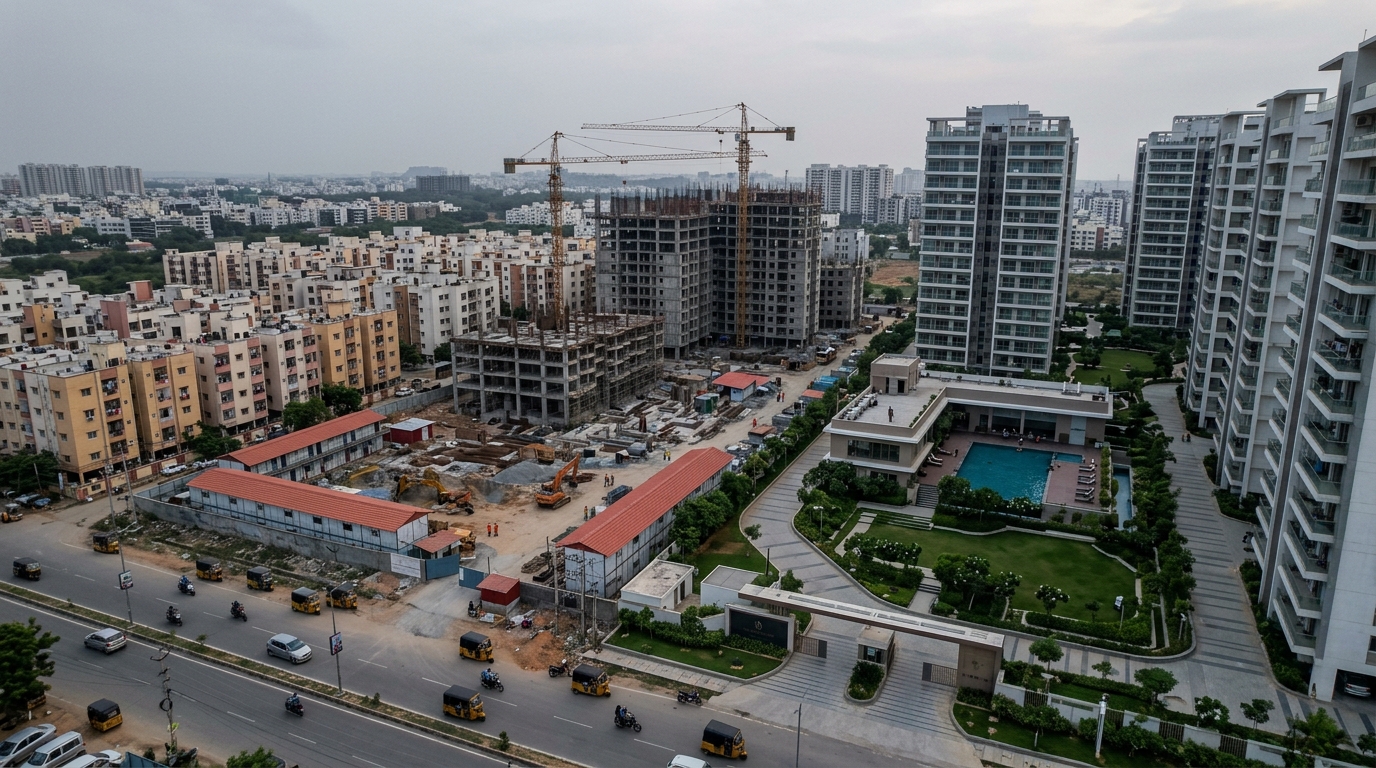
Demand-Supply Imbalance Fuels Affordable Housing Downturn
The latest data revealing a 23% contraction in affordable home sales across the top 8 Indian cities during the first quarter of 2026 is a stark indicator of an evolving market. This downturn suggests a growing disparity between the demand for budget-friendly housing and the available supply, or a shift in buyer sentiment towards other asset classes or higher-priced segments. While the exact causes require deeper investigation, potential factors include rising input costs impacting developer margins for affordable projects, increased financing costs for buyers, or a re-evaluation of the affordability index in these prime urban centers.
This trend directly impacts both demand and supply dynamics. On the demand side, affordability constraints are likely pushing a segment of potential homebuyers to postpone their purchase decisions or explore rental options. For supply, developers might be recalibrating their strategies, potentially shifting focus from high-volume affordable projects to mid-range or premium segments where margins are perceived to be higher, further exacerbating the supply gap in the affordable category. Consequently, pricing in the affordable segment, while potentially seeing some stabilization due to reduced demand, could also face upward pressure if supply continues to dwindle without corresponding demand adjustments.
- Reduced affordability due to economic factors (inflation, interest rates).
- Potential shift in developer focus to higher-margin segments.
- Buyer sentiment re-evaluation and postponed purchase decisions.
Institutional Investor Lens: Navigating a Shifting Landscape
For institutional investors, this 23% decline in affordable home sales presents a complex investment landscape. While the volume decrease might deter some from focusing solely on the affordable segment, it also opens avenues for strategic intervention. Investors might be looking for opportunities to bridge the supply gap through direct development or by partnering with developers focused on the affordable housing sector, especially if they anticipate a rebound or government incentives. The downturn could also signal a need for diversification, with capital potentially flowing towards rental housing solutions or niche segments that offer more stable yields.
The capital flow direction needs careful consideration. Traditional institutional investors might be reassessing their exposure to the affordable housing segment in these top cities, potentially diverting capital towards Tier II and Tier III cities where affordability is less strained, or to alternative real estate asset classes like logistics, data centers, or student housing. However, a contrarian approach could see astute investors identifying distressed opportunities or focusing on projects with strong underlying demand drivers and favorable regulatory support, aiming for long-term capital appreciation and stable income streams.
- Opportunity to address supply deficit through development partnerships.
- Diversification towards rental housing or alternative real estate assets.
- Potential re-evaluation of capital allocation to Tier II/III cities.
- Contrarian investment strategies in distressed affordable projects.
Policy & Regulatory Environment: A Catalyst for Change?
The observed trend in affordable housing sales could prompt a re-evaluation of existing government policies. While the news does not explicitly mention policy changes, a sustained decline in a segment critical for urban development might necessitate government intervention. This could manifest in the form of enhanced subsidies, tax incentives for developers building affordable housing, or stricter regulations on land use to encourage the development of budget-friendly units. Furthermore, policies aimed at improving access to finance for low and middle-income groups could be revisited to stimulate demand.
The impact of any new or revised policies will be significant. Targeted incentives can directly influence developer margins and buyer affordability, potentially reversing the current downtrend. For institutional investors, policy clarity and support are crucial for de-risking investments in the affordable housing sector. A proactive policy environment can encourage sustained capital inflow and contribute to a more balanced real estate market.
- Potential for enhanced government subsidies and tax incentives.
- Re-evaluation of financing accessibility for target demographics.
- Stricter land-use regulations to promote affordable housing development.
- Policy stability as a key driver for institutional investor confidence.
Hyderabad's Micro-Markets: A Closer Look
Hyderabad, being one of the top 8 cities experiencing this decline, warrants a granular analysis of its micro-markets. Areas like Gachibowli, Kokapet, and the Financial District, known for their IT and business hubs, typically attract a diverse workforce. While these areas are often associated with premium or mid-range housing, the ripple effect of a national affordable housing slowdown can still be felt. The demand-supply dynamics within these specific micro-markets for affordable housing would be particularly telling.
It's plausible that even in these high-growth corridors of Hyderabad, the squeeze on affordable housing is more pronounced. Developers might be prioritizing high-ticket projects, leading to a reduced pipeline of affordable units. For investors, this presents a dual scenario: a potential saturation in the premium segments might lead to increased interest in the affordable or mid-range segments, provided they are strategically located and cater to the needs of the burgeoning workforce. Understanding the specific absorption rates and rental yields for affordable properties in these micro-markets will be crucial for informed investment decisions. The availability of affordable housing in these job-rich areas is also directly linked to their long-term economic sustainability and attractiveness for businesses.
- Impact of national trend on Hyderabad's affordable housing segment.
- Analysis of demand-supply dynamics in Gachibowli, Kokapet, Financial District.
- Potential for increased investor interest in affordable/mid-range segments if premium markets saturate.
- Importance of micro-market specific absorption rates and rental yields.
Source: The Siasat Daily